This report offers a summary of the key discussions and outcomes from a dialogue session held in Bangkok in December 2025. The session, which took place during Regional Humanitarian Partnership Week, highlighted the significant impact of the Community-Led Innovation Partnership (CLIP) in Asia. This five-year program, running from 2021 to 2026, is also planning its future transition into a learning network.
1. Executive Summary
The Community-Led Innovation Partnership (CLIP) represents a fundamental shift in humanitarian programming—from top-down instruction to bottom-up innovation. Over five years of implementation across Indonesia, the Philippines, Guatemala, and South Sudan, CLIP has reached approximately 150,000 community members while generating measurable improvements in community resilience.
Final evaluation data shows that 75% of outcome statements represent documented improvement, with an equal proportion reflecting both expected and unexpected positive results. Most significantly, CLIP has demonstrated that when communities lead decision-making and resource allocation, innovations become more sustainable, contextually appropriate, and genuinely owned by those they serve. This report presents evidence from community innovators themselves on how consensus-building mechanisms drive lasting power shifts.
2. Introduction: The CLIP Approach
CLIP operates through a multi-layered partnership structure. At the international level, ADRRN Innovation Hub, Elrha and the Start Network coordinate funding flows and strategic direction. Country-level implementation is led by local civil society organisations: Yakkum Emergency Unit (YEU) in Indonesia, Centre for Disaster Preparedness (CDP) in the Philippines, with additional partners, ASECSA in Guatemala and Women for Change (WfC) and CAFOD in South Sudan. The programme has been made possible through flexible funding from UK Aid.
The core mission is deceptively simple: support locally-driven humanitarian solutions through both financial and non-financial means. In practice, this requires a fundamental reorientation. As Ikue Uchida, ADRRN Innovation Hub coordinator, noted during the programme’s session at the Regional Humanitarian Partnership Week in Bangkok, December 2025: “We’re so adapted to the top-down approach. But here, we want to make this bottom-up decision-making process.” This shift demands that supporting organisations unlearn established patterns of control and embrace genuine community leadership.
CLIP’s approach centres on fostering innovations that are contextually appropriate, locally-owned, impactful, and sustainable. Rather than prescribing solutions, the programme creates space for communities to identify their own challenges, design their own responses, and implement their own projects—with CSO partners providing enabling support rather than direction.
3. Evidence of Impact: Voices from the Field
Indonesia: From Followers to Leaders
Warsilah, chairperson of the Melati Women Farmers Group in Gunungkidul, Special Region of Yogyakarta, described the transformation in her community’s relationship to development programmes: “Before CLIP, we mostly followed orders from the office or the agencies—instructions to join their programmes. But through CLIP, things changed. With our innovation, the ideas and plans came from us. We discussed everything with the members, and because it came from the community, the sense of ownership became much stronger.”
Her group developed ‘PAPAH MEWAH’, a waste management innovation that addresses both drought and flooding risks. The project now serves over 157 households and has been recognised as a model group by village authorities. Profits from plastic waste collection support older people and persons with disabilities in the community. Warsilah herself has grown from someone who “used to be shy and could not speak in public” to a confident speaker addressing regional conferences.
Suwarno, treasurer of the Purwosari Millennial Farmers Group, echoed this shift: “Before, we just followed from the programme of the stakeholders. But through CLIP, we have the freedom to choose ideas and the innovations, and also to identify what kind of hazard we would like to address.” His group developed a drip irrigation system that reduced water consumption by more than 50%—from five tanks per planting season to just two for 400 chilli seedlings. Combined with their transition to organic farming, harvest profits increased from approximately $200 to $1,200 per season—nearly a six-fold increase.
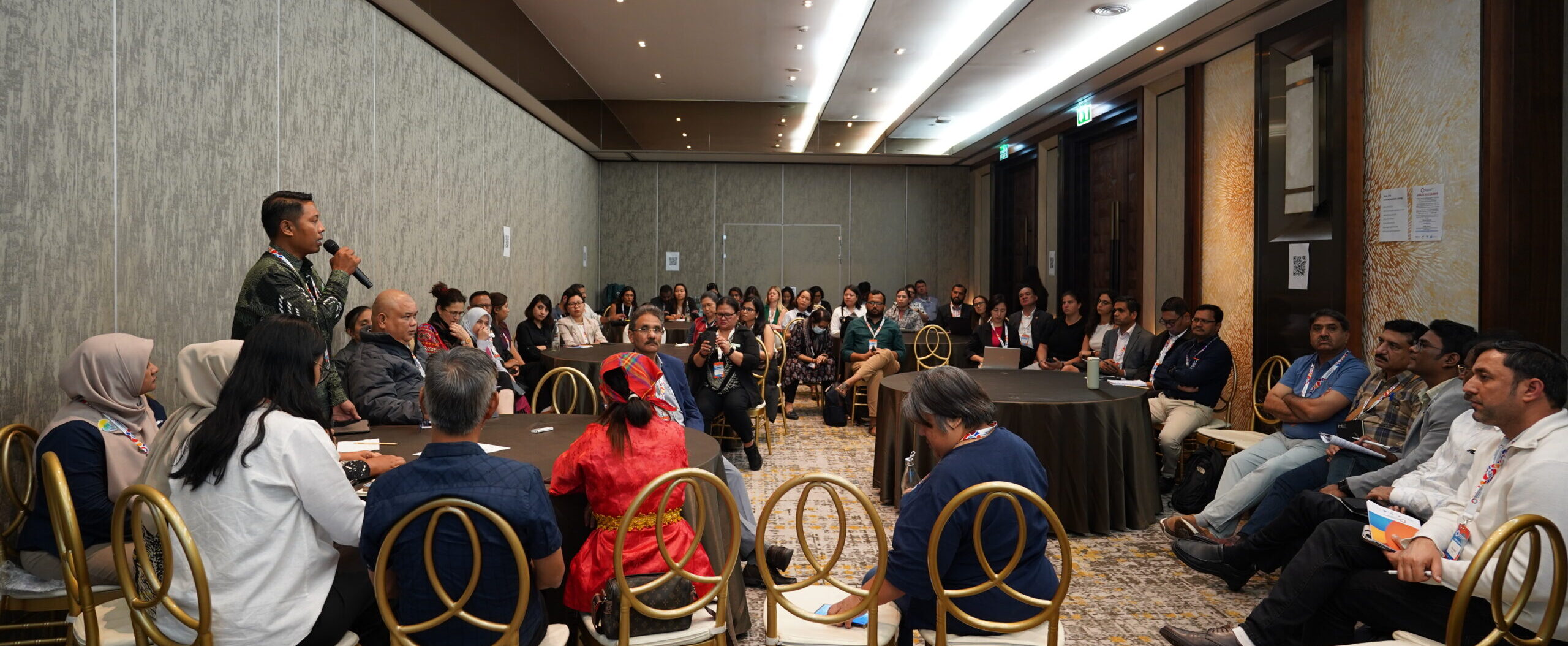
Suwarno presenting the innovation project and his journey
Philippines: Inclusion and Cultural Innovation
Engineer Darlito Palermo leads the ‘Lingkuranan sa Kagawasan’ (Chair of Freedom) project—a rattan wheelchair innovation for children with disabilities. The project exemplifies CLIP’s approach to inclusive, culturally-grounded solutions. “From the very beginning, we knew that any solution must be rooted in the real experience of our people,” Palermo explained. “We started with open consultation, listening to wheelchair users, families, caregivers, and community leaders.”
The innovation brings together local rattan artisans, disability advocates, health professionals, and local government. The result is a wheelchair that is accessible, affordable, sustainable, and culturally meaningful. The project has received recognition from the Department of Science and Technology and has been presented internationally. More importantly, it has created livelihood opportunities for artisans while providing mobility solutions that families can maintain locally.
Zenith Balerta, president of the Pandan Tri-people Women Organisation and a survivor of armed conflict, described how crisis drove consensus-building among Teduray tribe women: “Since our community is very far from the health centre, and health centre staff cannot come because of security fears, these circumstances push us, the women, to build consensus.” Her group established ‘Lawi-Fatinaan’ (House of Healing), producing herbal medicines, first aid supplies, and serving vegetables to internally displaced persons. The local barangay has since donated land for their centre, and Zenith was recognised with an ADRRN Leadership Award at the Asian Ministerial Conference for Disaster Risk Reduction (APMCDRR) in Manila, October 2024.
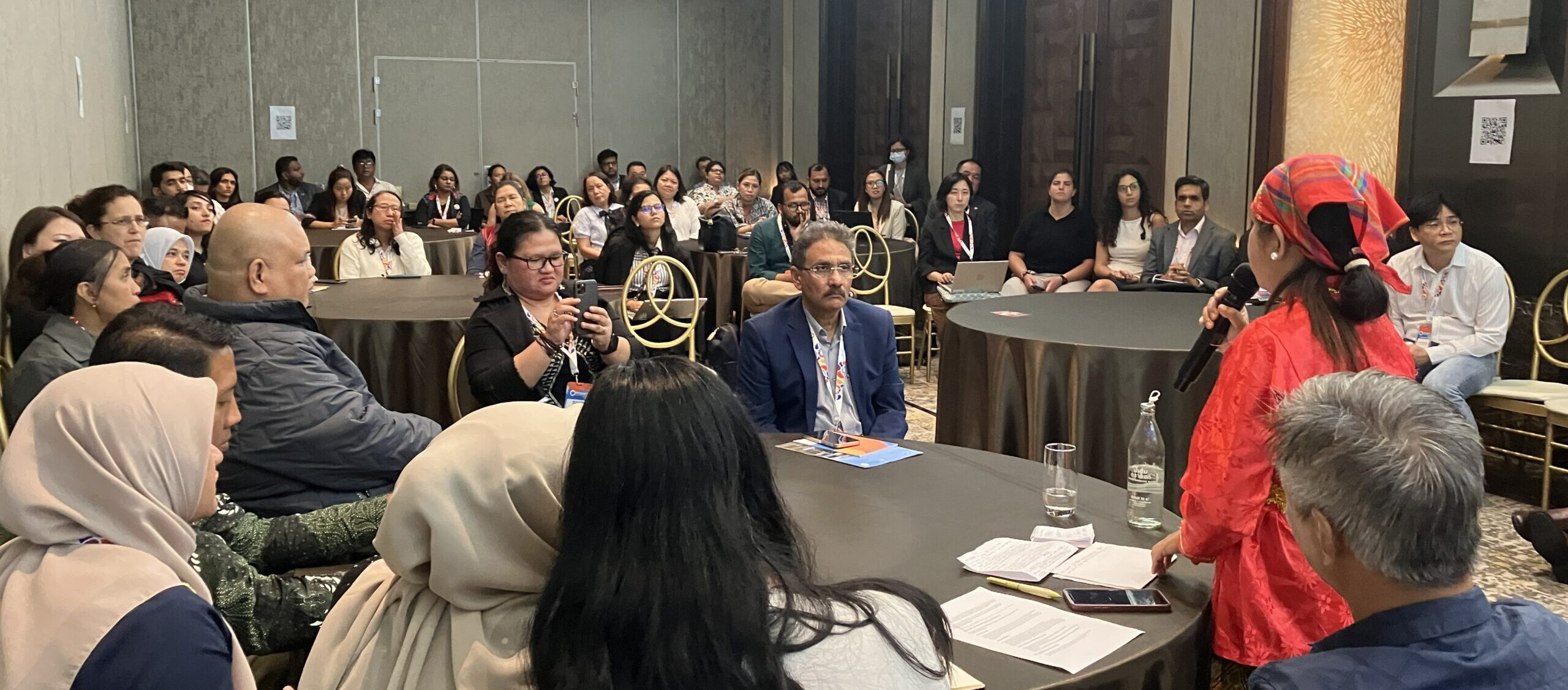
Zenith sharing her experience as a community leader
4. How Consensus-Building Shifts Power Dynamics
A consistent theme across all community innovators is the fundamental change in their relationship with external stakeholders. Suwarno articulated this transformation clearly: “There is an inspiration. We are no longer just following instructions from the externals. Now we have the freedom of the idea and also to choose the solutions to address our problems. We have our own suggestions, we become stronger, and the ownership to sustain this is much higher.”
This shift has tangible effects on resource flows. Suwarno’s farmer group, despite offering lower bids, now receives priority consideration from village government for land auctions—a direct result of their demonstrated commitment and organisational capacity. The Agriculture Extension Office and Ministry of Agriculture actively support their innovations. As Suwarno noted: “Because all decisions were made through consensus, all the members felt strong ownership, and that ownership is what made our innovation succeed.”
Overcoming resistance requires patience and persistence. Both Indonesian and Filipino innovators shared stories of initial sceptics who later became active supporters. Zenith described a woman leader who threatened to “cut off her finger” if the project proceeded—that same woman is now an active member who “supports me always during activities.” The approach: “Good intentions, sincerity, and continuous invitation.” Warsilah faced similar challenges when a group member’s idea was not selected; through persistent invitation, that member eventually rejoined the group.
5. The CSO Support Model: Enabling Without Leading
Supporting organisations face the challenge of providing genuine support without reverting to top-down control. Jessica Novia of YEU Indonesia summarised their approach: “We spend a lot of time creating space for the innovators, and we genuinely listen to their needs. Never make assumptions. Everything, we always consult back to them. We guided them, but all of the words are coming from them.”
YEU contextualised CLIP as embodying ‘idea, innovation, inclusion, and action’. Their support model includes transferring organisational knowledge (including safeguarding protocols), capacity strengthening tailored to individual needs, simplified accountability systems, and risk-sharing that allows communities to pivot when circumstances change. When one farmer group discovered their community was resistant to catfish farming, YEU supported them to shift to vegetable growing instead—maintaining the programme’s integrity while respecting community preferences.
Edgar Lascano of CDP Philippines emphasised similar principles: listening, believing in community capacities, and nurturing skills. CDP provides training on advocacy, lobbying, pitching, and financial management—building the capabilities communities need to sustain their work independently. As Lascano noted: “Since the communities themselves are the ones directly affected and they know what works best for them, they made the decision at every step of the innovation process.”
A participant from Start Network Pakistan captured the essential insight: “We are not the representatives of the community. We are the enablers. They are the real leaders. When the community leads, youth enables, and government owns, then there is no way that success and sustainability can be stopped.”
6. Key Success Factors and Lessons Learned
Several factors emerged as critical to CLIP’s effectiveness. Flexible funding was repeatedly identified as essential. Jessica Novia illustrated this with a practical example: when a community planned to purchase 10,000 avocado seedlings but only 8,000 were available, flexible funding allowed them to adapt—purchasing alternative seedlings or investing in marketing training instead. Rigid funding frameworks would have stalled the project entirely.
The trust-building work that enables community leadership is often invisible and unfunded. As one participant noted: “The effort that YEU and CDP are doing on the ground takes a very long time, which is usually sadly unfunded.” Yet this groundwork is essential for genuine community ownership to emerge.
Simplified accountability mechanisms matter. Rather than requiring communities to produce formal written reports, YEU’s community organisers conduct dialogue-based monitoring and write up findings themselves. This respects community capacity while maintaining accountability to donors.
The permission to pivot—to adapt innovations when circumstances change—is built into the programme design. This flexibility, combined with genuine risk-sharing between CSOs and communities, creates the psychological safety needed for honest communication and adaptive management.
7. Recommendations for Future Investment
CLIP demonstrates that community-led approaches deliver measurable impact across multiple domains of resilience—from basic services to social capital to financial resources. For donors considering future investment in localisation, this experience suggests several priorities.
Multi-year, flexible funding enables the trust-building and adaptive management that community leadership requires. Investing in the “invisible” relationship work of local CSOs pays dividends in programme sustainability – creating more of a locally led innovation ecosystem rather than a series of dissipated projects. Partnership structures that transfer organisational knowledge and privilege—not just funds—build lasting community capacity. Finally, simplified accountability mechanisms can maintain rigour while respecting community realities.
As a participant from Community World Service Asia observed: “This process is not a projectised process for one month, one year, two years. It’s a lifelong process. And as we as organisations accept their empowerment, we should also influence our financiers. They need a lot of flexibility also.”
The evidence from CLIP is clear: when communities lead, innovations are more sustainable, more contextually appropriate, and more genuinely owned. The challenge for the humanitarian sector is creating the conditions—through funding, partnership structures, and organisational culture—that allow community leadership to flourish.